
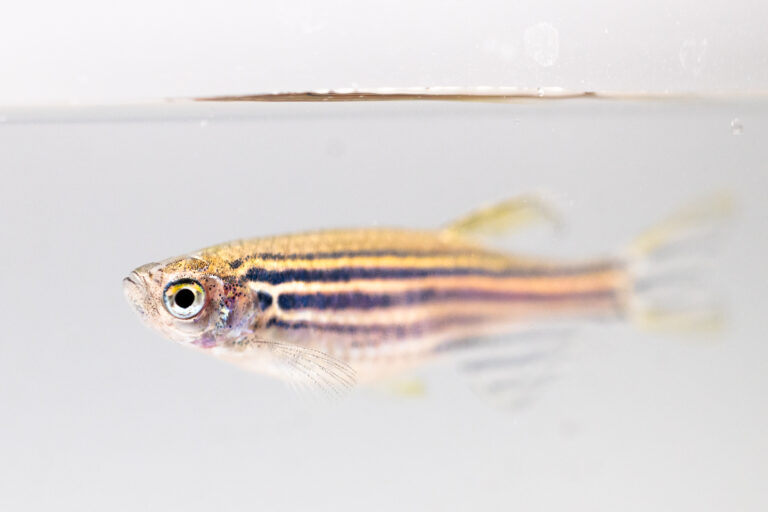
What if one of medicine’s most powerful tools wasn’t a drug, a machine, or a lab-grown organ — but a small, striped fish about the size of your thumb? In our latest Stories of Impact episode, we explored exactly that. Zebrafish are quietly revolutionizing biomedical science, and the story of how they do it connects the ocean, the classroom, and the future of human health in ways that speak directly to everything we care about at the Becky Valentine Foundation.

Meet Danio rerio: The Little Fish With Big Answers
The zebrafish (Danio rerio) is a freshwater tropical fish native to the rivers of South Asia — small, fast-breeding, and utterly unassuming. You might recognize them from a pet store tank. But in laboratories around the world, they are doing something extraordinary: standing in for human beings in the study of cancer, heart disease, neurological disorders, diabetes, and much more.
How is that possible? The answer lies in genetics. According to a landmark genome study, approximately 70% of all human disease genes have a functional counterpart — called a homolog — in zebrafish. Research published in Frontiers in Cell and Developmental Biology goes even further, finding that over 80% of proteins that cause disease in humans have an equivalent in zebrafish. That’s a staggering overlap between a fish and a person, and it forms the scientific foundation for one of the most important research tools in modern biomedicine.
— Frontiers in Cell and Developmental Biology

Why Zebrafish? The Science Behind the Choice
Of course, humans and mice share even more genetic similarity — so why not just study mice? The answer has to do with practical advantages that make zebrafish uniquely powerful for large-scale research. As reviewed in Nature Reviews Genetics, zebrafish offer a combination of properties no other vertebrate model provides:
- Optical transparency. Zebrafish embryos are see-through. Scientists can watch a tumor form, observe a beating heart, or track labeled cells moving through a living body — in real time, without surgery.
- Rapid development. Major organs are fully formed within 24 hours of fertilization. A complete generation cycle takes just a few months.
- High yield. A single pair of zebrafish can produce 200–300 eggs per week, enabling studies at a scale impossible with mammals.
- Cost-effectiveness. Maintaining a zebrafish colony requires a fraction of the space and resources needed for mice or rats, making large-scale genetic and drug screening practical.
- Genetic tractability. Modern tools like CRISPR gene editing work exceptionally well in zebrafish, allowing scientists to switch specific genes on and off to study their role in disease.
Together, these features have made zebrafish one of the most-used model organisms in biomedical science — and the pace of discovery is accelerating. Researchers are now using zebrafish to model conditions ranging from leukemia and autism spectrum disorder to osteoporosis, atrial fibrillation, type 2 diabetes, ALS, and epilepsy. Each discovery in a fish tank has the potential to translate into a new therapy for a human patient.
The Ocean–Health Connection: Where Marine Science Meets Medicine
Here’s where the story gets especially meaningful for those of us at the Becky Valentine Foundation and for anyone who believes that protecting our natural environment and advancing human health go hand in hand.
Zebrafish are a freshwater species, but they belong to a broader scientific tradition that has long looked to aquatic organisms for answers about human biology. Two of the nation’s most respected marine research institutions are helping lead this charge.

The Rosenstiel School of Marine, Atmospheric, and Earth Science
At the University of Miami’s Rosenstiel School of Marine, Atmospheric, and Earth Science, scientists have long understood that the ocean is not just an ecosystem to protect, it’s a source of medical knowledge. The school’s recently launched Glassell Family Center for Marine Biomedicine embodies this vision, bringing together 35 faculty members from across the university to work at the intersection of ocean science and human health. Researchers there are exploring novel antibiotics from coral, therapies for stroke derived from marine organisms, and using aquatic models — including zebrafish — to study the health effects of environmental pollutants like heavy metals, PFAS, and microplastics.
Dr. Rachael Heuer, a Research Assistant Professor at the Rosenstiel School, uses zebrafish directly in her research to investigate how environmental toxicants affect neural and cardiovascular systems — work with enormous implications for public health in communities exposed to industrial pollution. The Rosenstiel School’s National Aplysia Resource, the only facility in the world that cultures sea hares for scientific research, previously helped lay the groundwork for a Nobel Prize in physiology. Zebrafish are the next chapter in that story.

The Scripps Institution of Oceanography
On the West Coast, the Scripps Institution of Oceanography at UC San Diego has built one of the world’s most innovative marine biomedicine programs through its Center for Marine Biotechnology and Biomedicine (CMBB). CMBB researchers work at the intersection of ocean sciences and human health — including marine drug discovery, the ocean microbiome, and the development of model systems from marine organisms to supplement traditional mammals in biomedical research. With over 20 government-approved marine-derived or marine-inspired drugs on the market, Scripps is proving that the sea holds answers medicine has not yet fully explored. The same biological curiosity that drives ocean conservation is fueling breakthrough cancer therapies and antiviral medications.
What This Means for STEM Education and Underserved Youth
At the Becky Valentine Foundation, our mission centers on three interconnected pillars: STEM education and scholarships for underserved youth, environmental stewardship, and broader community impact. Zebrafish research sits at the precise crossroads of all three.
Stories like this one — a freshwater fish illuminating the mysteries of Alzheimer’s disease, a coral reef compound becoming a cancer drug — are exactly the kinds of narratives that ignite curiosity in young students. They demonstrate that science is not confined to a textbook or a single discipline. A student who falls in love with marine biology might find herself, one day, developing a treatment for Parkinson’s disease. A student passionate about environmental protection might discover that his work preventing pollution directly protects the health of vulnerable communities. STEM is not siloed. It is a living, breathing web of discovery — and every young person deserves access to that world.
Through our partnerships and our ongoing commitment to creating pathways for students from underserved communities, the Becky Valentine Foundation believes that the next great discovery in marine biomedicine might come from a student who, today, simply needs a chance.
Environmental Stewardship Is Health Stewardship
There is one more dimension to this story worth naming explicitly. The zebrafish research happening at institutions like the Rosenstiel School is not only advancing human medicine — it is sounding an alarm. When scientists use zebrafish to study the neurological effects of microplastics or the cardiovascular damage caused by industrial chemical runoff, they are doing something that matters far beyond the laboratory. They are showing us, in vivid biological detail, what we lose when we allow our waterways to degrade.
The health of our ecosystems and the health of our communities are not separate concerns. They never have been. Protecting the ocean, preserving clean water, and reducing chemical pollution are not just environmental priorities — they are public health imperatives. This is why the Becky Valentine Foundation’s commitment to environmental stewardship is inseparable from our commitment to human flourishing.
Watch Our Stories of Impact Episode
In our recent Stories of Impact episode, we went deeper into the world of zebrafish research and spoke with scientists and educators about what this work means for the future of medicine, the future of ocean science, and the future of the next generation of STEM leaders. We invite you to watch, share, and join the conversation.
Science is most powerful when it is accessible — when young people can see themselves in it, when communities benefit from it, and when the natural world that makes it possible is protected. That is the world the Becky Valentine Foundation is working to build.
Support the Next Generation of Scientists
The Becky Valentine Foundation provides scholarships, environmental education, and community programs that open doors for underserved youth in STEM. Your support helps make discoveries like these possible — and ensures that the scientists who make them look like the communities they serve.
Sources & Further Reading:
• Zebrafish Models for Human Disease Studies — Frontiers in Cell and Developmental Biology
• Animal models of human disease: zebrafish swim into view — Nature Reviews Genetics
• Effectiveness of zebrafish models in understanding human diseases — PMC / NCBI
• Glassell Family Center for Marine Biomedicine — University of Miami Rosenstiel School
• Center for Marine Biotechnology and Biomedicine — Scripps Institution of Oceanography
• Adult zebrafish as advanced models of human disease — Disease Models & Mechanisms